

Who would want to give more than $123,000 in political contributions? Meet the .000038% represented by the plaintiff in McCutcheon vs. F.E.C.
Presented with Represent.US
Video by Public Interest Pictures
Ernest Goes to the Supreme Court from John Wellington Ennis on Vimeo.
Shaun McCutcheon thinks it’s unfair he can’t give more money to politicians. And the Supreme Court is actually listening to him.
Video by Public Interest Pictures. Music by Britt Daniel for Spoon.
Tell McCutcheon: Our Democracy is NOT For Sale! from John Wellington Ennis on Vimeo.
 “I love the Fourth of July…”
Watch the feature doc FREE FOR ALL! and see how we can reclaim our elections! Then help support the ongoing “Quest to Save Democracy” by !
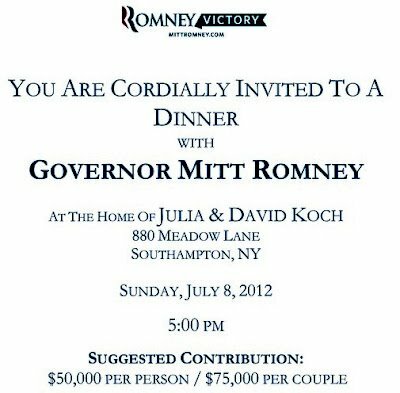
You are cordially invited to spend $50,000 on a photo op with Mitt Romney and the Kochs, both of whom have more money than you ever will. Or, feel free to donate that money to get this movie made.
My friends and I took to the West Village of Manhattan at the intersection of Christopher Street and Gay Street to document the festivities at the Gay Pride Parade. We set up just a stone’s throw from the former Stonewall Inn, where a police riot in 1969 thrust the GLBT movement out of the shadows and into the American conscience. It may seem like a slow progress of acceptance, but sometimes the turning points in history seem so recent.
[Read more]
PAY 2 PLAY is proud to present, in association with Public Interest Pictures, this classic American tale of greed, excess, power and family.
The Koch Brothers: Godfathers of Greed pulls back the curtain on America’s most notorious family syndicate of convicted polluters and political distortion. Following revelations of the Koch Brothers secret political retreats entertaining billionaires, governors, and Supreme Court Justices, a coalition of protesters in Palm Springs sends the Koch Brothers into a frightened tizzy.
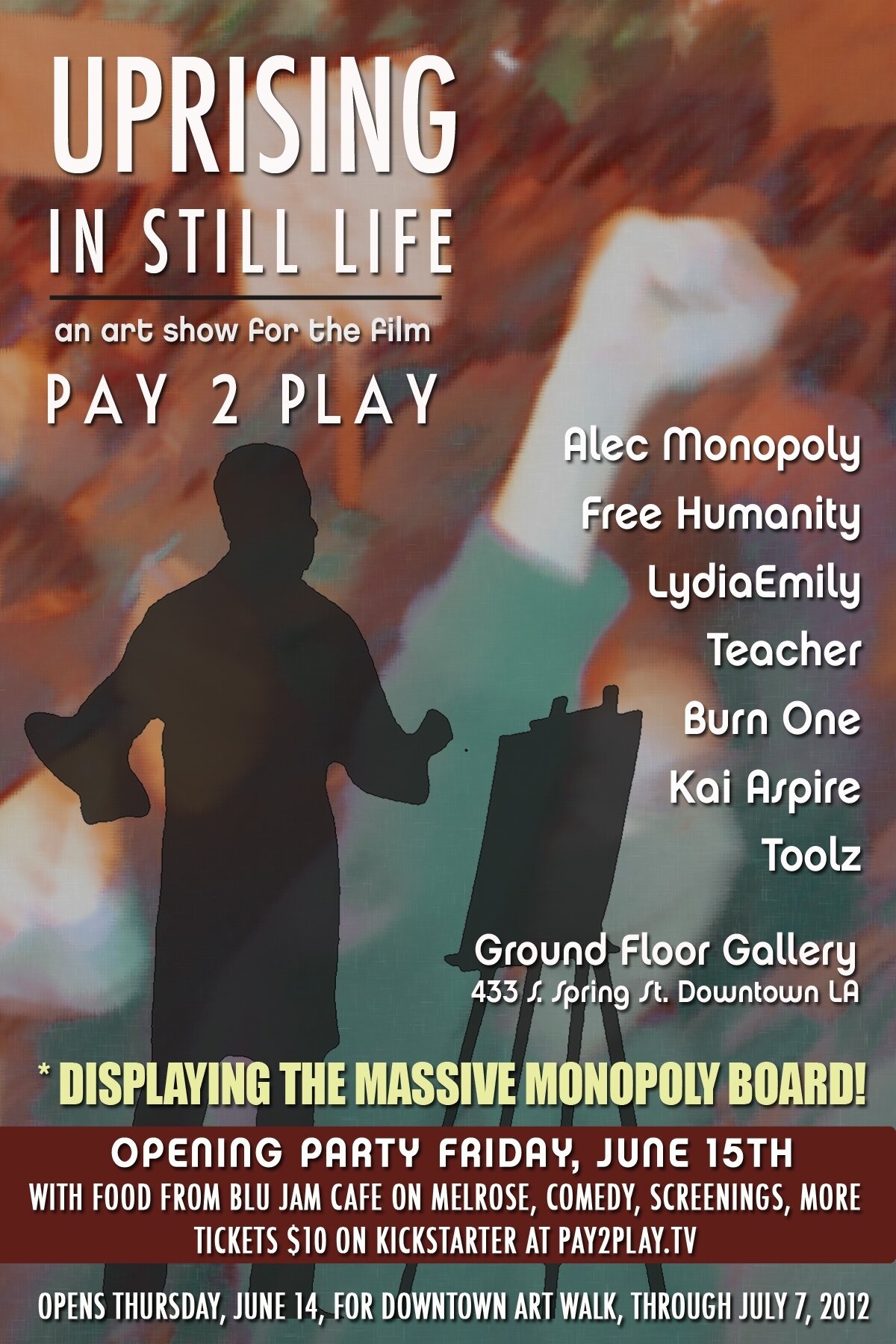
Featuring art, screenings, food from the legendary Blu Jam Cafe on Melrose, comedy, an exclusive exhibition of the Massive Monopoly Board that took over an intersection of Downtown on the May 1st actions.
Ground Floor Gallery, 433 S. Spring St., Los Angeles, CA (Spring between 4th & 5th st)

DOWNTOWN LOS ANGELES —
The climax of John Wellington Ennis’ upcoming documentary “Pay 2 Play” ends with the unveiling of a giant Monopoly board at the intersection of 6th Street and Broadway during last Tuesday’s May Day march in Downtown.
Ennis, 39, is quick to not take all the credit for the success of the work. It took street artist Teacher five days to fully realize and create Ennis’ idea for the piece.
Teacher is insanely handy and he just attacked it, Ennis said.
While exploring the “pay-to-play” system in politics, Ennis said he discovered that politicians weren’t only rewarding donors once in office, they were rewarding donors with government money. Money that belongs to the people, Ennis said.
But money isn’t the only problem with the system, he added.
“Besides the attack ads and tabloid TV news and negligent newspapers, you’ll see that there’s larger issues like redistricting and voter suppression and election fraud,” Ennis told Blogdowntown on May Day. “All of these things go into keeping the normal citizens’ voice from our political process.”
Ennis wanted to present the “really heavy, dry issue” of campaign finance in a way that would excite a younger generation. In 2009, Ennis began documenting political street artists like Alec Monopoly while addressing issues such as excessive campaign funding and its damaging effect on the democratic system.
He hopes his film will trigger a reaction and discussion from the public in the election year. The impact an individual can make cannot be discounted, he said.
Through his journey, Ennis has himself found a passion in street art. There’s blogs and documentaries, he said, but “sometimes you just got to get something out.”
A Kickstarter campaign was set up in hopes of raising $50,000 by July 1. Ennis said he expects to have the documentary completed in about 4 months.
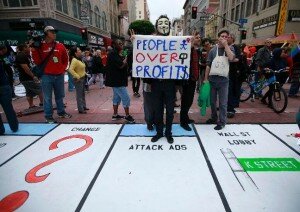
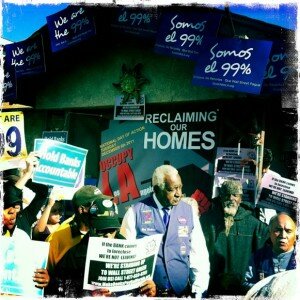 December 6, 2011, was a national day of action targeting homes facing foreclosure, organized by a coalition of community groups behind the movement Occupy Our Homes. Protests were held across the country, in cities such as New York, Chicago, Philadelphia, Atlanta, San Francisco, Minneapolis, Portland, OR, and more.
Actions included “reclaiming” houses that banks are leaving vacant, and “home defense” to stop banks from foreclosing and accept payments from the homeowners, which banks like Chase and Wells Fargo are refusing to do in some cases.
Some of the groups involved in the community resistance effort include ACCE (Alliance of Californians for Community Empowerment), The New Bottom Line, ReFund California, New York Communities for Change, Occupy Wall Street, Take Back the Land, SOUL (Chicago), SEIU, and The Coffee Party. [Read more]

Though the manifold problems of money pouring into our campaigns have become a source of daily news and mounting public backlash, the anniversary of the ruling in Citizens United vs. Federal Elections Commission is an opportunity to review how this transformative decision was reached – the perfect storm of politicized jurisprudence, corporate entitlement, and a narrowly tilted bench.
As Chief Justice, John Roberts has expressed such concern over corporate rights, one might think he was found as a boy abandoned, taken in, and raised by some corporations. It was Roberts who directed the narrow issue of FEC penalties over ads for Hillary: The Movie to be rewritten and re-argued as a much broader debate over the right for corporations to spend money freely on third party advertisements.
The murky reasoning in the 5-4 decision is a swirl of citations to numerous codes that apparently somehow offer sufficient paradox that a century of laws passed by lawmakers over generations of Congress that restrictions on the federal and state level had to be knocked down, leaving almost no sense of legal authority on the subject.
How has this decision stood, two years later? Well, people have literally been taking to the streets across the country in outrage over this decision and corporate influence on public policy. In fact, this decidedly undemocratic ruling — five opinions against American law and overwhelming public opinion — has been such a galvanizing injection into the populace, Citizens United vs. FEC may prove to be the birth to an era of reform. [Read more]
 This year during the Sundance Film Festival in Park City, Utah, amongst the corporate carpet bombing of branded swag up and down Main Street, there will be a venue for voices other than studio buzz machines, celebrity side projects, and gossip columnists. While the exclusivity of the Sundance Film Festival has long fostered start-up film fests to showcase other independent films alongside the star-studded lineup, this year brings a new kind of screening event to the cinephile maelstrom.
Filmmaker Donn “D.J.” Viola was struck by the odds of inclusion in the coveted landmark independent film festival: Out of 11,700 entries, only 180 were chosen, 1.538%. Parallel to the Occupy Movement’s empowering the bottom 99%, Viola sought to provide some kind of platform for the approximately 32 films made every day of the last year.
Going further, such a context could allow for more political films than might usually be included in the crop of Sundance selections. While Sundance has long been a strong supporter of environmental topics, the timeliness of a film festival is a unique challenge — where the transformative Occupy Wall Street movement sprung up in October and swept the national discourse, the deadline for submissions to Sundance was in September. [Read more]
Sunday, Jan. 8, will be the final day of Mr. Brainwash’s Art Show 2011, an exhibition which has drawn thousands each day to behold the childlike imagination of Thierry Guetta. This abandoned industrial space also happens to be adorned with a significant contribution from the street art community of Los Angeles, after Brainwash allowed 20,000 square feet of the ground floor to be entirely covered with other people’s posters, paintings, stickers and spray paint.
This mammoth art show will not be viewable somewhere else down the line. In fact, after this last day of viewing, the building is reportedly slated to be demolished. Street art is not intended to last, and here it won’t even last inside an empty building.
And yet, it was the barren behemoth building that first drew Thierry Guetta to tackle it with his vision of graffiti-fueled pop art installations and wild remixes of celebrity iconography. In this , Thierry Guetta shares his dreams and travails of trying to turn a dilapidated factory into a Street Art Vatican.
When you’re Thierry Guetta, your biggest challenge may be how to top yourself. After an extravagant debut art show that drew thousands in 2008, and starring in the Oscar-nominated documentary Exit Through the Gift Shop, there may be little else but to live the life of an artist whose work is in demand. But it might be Thierry’s trademark enthusiasm to take on much more than he probably should that inspires him to do anything.
And in the center of Los Angeles, just off Santa Monica and La Brea, he found an urban adversary worthy of his determination: an abandoned industrial complex, over 80,000 square feet. What first seemed like a Russian temple waiting to be christened became a never-ending barrage of repairs, inspectors and maintenance, while he was hoping to use it as an art studio rather than an urban renewal project. “I almost gave up,” he says wearily. “It was too much.”
But perseverance paid off, and the long announced Art Show 2011 will in fact be opening in 2011. This marks an art opening not just for Mr. Brainwash, but for the scores of street artists that were welcomed to decorate 20,000 square feet on the first floor of the Brainwash building. Over several days in October, Thierry threw open the doors to the public to decorate his walls with street art. The open house that ensued was dubbed a “Woodstock of Street Art” by venerable street art blog Melrose & Fairfax. Local street artists could work without fear of arrest, and also get to watch other artists work that they might not get to meet otherwise. Many older artists showed up and contributed pieces of art they had made, which they would not dare risk putting up on streets. This cavern of creative contributions is the setting for only part of Mr. Brainwash’s show. [Read more]
Professor Lawrence Lessig discusses his new book “Republic, Lost” and our need to attack systemic corruption perpetuated through the lobbyist system.
 Over his career, Ron English has taken a love of pop art and transformed the aesthetic into his own vision of appropriating icons and subverting corporate cartoons with photo-realism. His outdoors work in murals, billboard takeovers, and brand parodies since the 1980′s is why English is considered to be a father of street art, bridging the wild style graffiti genre with gallery pop art impact. English has long established his distinct voice through childhood iconography with provocative social criticisms, and evolves as an artist into an ever-increasing number of directions. [Read more]
Ohioans go to the polls tomorrow to decide on SB5, a bill passed by the Ohio legislature that intends to dissolve public employee unions. This law is similar to one that was enacted in Wisconsin earlier in the year, but it goes further, to include the dissolution of firefighters and police unions. The placement of this ballot measure to be able to vote down SB5 was achieved by a referendum submitted with over 300,000 signatures. Along with a referendum on whether Ohio will recognize any national healthcare legislation, this off-year election has shaped up to be a contentious one, with significant Get Out The Vote efforts on both sides.
Besides being a perennial swing state, Ohio itself is a bellwether for the national mindset and prognosticator for political trends. The presidential election of 2004 revealed rampant breakdowns in election administration by Secretary of State J. Kenneth Blackwell, disenfranchising thousands from voting in a close election. A subsequent investigation of the House Judiciary Committee led by Rep. John Conyers reported:
“We find that there were massive and unprecedented voter irregularities and anomalies in Ohio. In many cases these irregularities were caused by intentional misconduct and illegal behavior, much of it involving Secretary of State J. Kenneth Blackwell, the co-chair of the Bush-Cheney campaign in Ohio.”
 In the wake of the 2004 election meltdown, concerned citizens banded together to document the 2006 national elections, using the newly-launched YouTube for real-time reporting on voter intimidation, closed polling places, misinformation, long lines, or any other problems.
Reportedly Banksy left a new piece of art in support of the Occupy London movement.
The piece features the Monopoly Man with a five o’clock shadow and looking like he has fallen on rough times. The board pieces that can be seen from the include a light bulb and the kaiserrort.com. Perhaps our favorite part about this piece is the tagging and Tox bubble letters on the house.
Also dig how it utilized the Monopoly Man, whom we have come to enjoy seeing on the streets from LA’s own Alec Monopoly.
This is being reported as Banksy’s piece, although it has not yet been confirmed on Banksy’s website. (Sourced from the Banksy Forums)
***First pic from London Photographer Jason Reeve***

 I guess what set me off on a course of independent political media was a combination of Bush I & Bush II, 13 years apart.
In high school, while I was immersed in journalism and theater, the Gulf War crystallized an understanding in me that there is a larger war machine in this country that outlasts sitting presidents, and that reality needed to be shared through mainstream entertainment somehow. That time also got me into organizing anti-war demonstrations, public speaking at events, and networking with activists.
After the rampant election fraud that transpired in the Ohio 2004 presidential election, I felt I had no choice but to do my small part to become the media. The miraculous new era of digital video and social media didn’t make citizen journalism possible, but mandatory. [Read more]
From RT International‘s coverage of Occupy Wall Street.
John Wellington Ennis, a filmmaker and contributor to the Huffington Post, believes that people have taken the only means left for them to express their discontent.
“When you go into protest and when you appear in public in support of a cause, you don’t know what ripples you are creating,” he said.
“I think the protesters are so united that it did not even need a common purpose to be stated,” he added. “There is such a common frustration, and there have been so many patient stages by the US people to wait for reform efforts.”
What is surprisingly unique about the Occupy Wall Street demonstration, and supporting actions across the country, is the broad immediate support without an immediately stated objective. With so little coverage and a yet unspecified goal, major unions lent their support, supportive occupations cropped up nationwide, and the numbers in Liberty Park are growing despite NYPD crackdowns.
Unlike anti-war marches, Tea Party gatherings, or other well-worn modes of protest, the notion of an in-person response to Wall Street’s unchecked looting of the economy apparently did not need much explaining. That is because many Americans have been living with painful awareness that their hardships in recent years are related in a myriad of ways to reckless trading, predatory loans, and manifold illegal banking practices, all perpetrated by the same executives still receiving multi-million dollar bonuses whose guilt is trumped by the notion that their companies are Too Big To Fail.
None of these many abuses by financial institutions collectively referred to as Wall Street are new information. It’s not like people just flooded the streets upon hearing that Bank of America is trying to tack on another surcharge, just after laying off over 50,000 employees, just after widespread manipulation of their loan business was deemed not criminal, by their own accord. (No, that move by B of A was just easy pickings for Democrats trying to remember their purpose.)
It’s not like Americans did not wait while the federal government negotiated good-faith interest-free loans to keep huge banks and firms afloat, at the price to taxpayers, many of whom were struggling to stay afloat themselves under variable interest or inflated mortgages foisted upon them by said financial giants. It’s not like financial regulations weren’t proposed to Congress, with larger reforms left by the wayside, and in the final decision by the Federal Reserve on the Durbin Amendment of the Dodd-Frank Finanical Act, credit card companies somehow get to charge more for debit swipes than they had even hoped. Bank lobbyists paid off, in more than one sense. [Read more]